Posts Tagged ‘ceramic soldering’

S-Bond® Solders At the Interface of the NanoBond® Process

Friday, January 27th, 2012
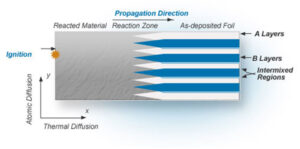
NonoBond heating process1 300x149 S Bond® Solders At the Interface of the NanoBond® Process

Figure 1. Illustration of the NanoBond® / NanoFoil® heating process® (from www.indiumcorp.com)

S-Bond active solder layers have been shown in many applications to be the key ingredient that permits many ceramics and refractory metals to be bonded to largely coefficient of thermal expansion (CTE) mismatched metals such as aluminum and copper. Indium Corporation offers a NanoBond® process that uses NanoFoil ® as local heat source to remelt preplaced solder layers without the need for the bulk heating of assembled components that have large CTE mismatch. Active S-Bond solders are applied as prelayers and have Ti, Ce, Ga and Mg additions that permit them to wet any ceramic or metal surface. Once the S-Bond pre-layers are applied to ceramic and/or metallic surfaces, conventional solders can be reflowed onto the S-Bond layer to create the preplaced solder layers that are remelted and bonded via the heat emitted from an ignited NanoFoil®. Figure 1 illustrates how temperatures of over 1,400 K are generated by an ignited nano-engineered foil.

Figure 2 illustrates the use of S-Bond in the NanoBond® process in bonding sputter targets.

s bond applied nanobond process S Bond® Solders At the Interface of the NanoBond® Process

Figure 2. An illustration of S-Bond being applied in the NanoBond® process

NanoFoil® , sold by Indium Corporation, is used on the Nanobond® process as a heat source to only locally reheat a pre-soldered interface with an instantaneous release of heat energy for joining applications. NanoFoil® is a nano-engineered material fabricated by vapor-depositing thousands of alternating nanoscale layers of Aluminum (Al) and Nickel (Ni), as shown in Figure 1. When activated by a small pulse of local energy from electrical, optical or thermal sources, the foil reacts to precisely deliver localized heat up to temperatures of 1500°C in fractions (thousandths) of a second. As a sacrificial heat source in soldering and brazing applications, NanoFoil® is ideal for high-temperature applications. NanoFoil® becomes a non-functional part of the solder or braze joint, eliminating the need for an oven or furnace and allowing for the use of higher temperature solders.

NanoFoil® works by acting as a local heat source to melt adjacent solder layers without heating the target or backing plate materials. This allows the bonding of nearly any combination of sputter target material and backing plate material, including ceramics to metals, irrespective of the difference in coefficient of thermal expansion (CTE). S-Bond solders enable the NanoBond® process in many applications by providing an “activated / bonded layer” on the ceramic or metal interface to which conventional solders can wet and adhere.

Contact us for more information on how S-Bond can assist your NanoBond® applications.

NanoFoil® and NanoBond® are registered trademarks of Indium Corporation.

S-Bond Joining of High Brightness LEDs

Friday, January 27th, 2012

S-Bond active solder joining is emerging as an effective method to bond heat sinks to the back of High Brightness Light Emitting Diodes (HBLEDs). Active solders can wet and adhere to many of the thermally conductive ceramics (AlN, BeO, etc.) that are being used in HBLED’s and enable effective and thermally stable and conductive joints.

schematic hbled heat sink 300x170 S Bond Joining of High Brightness LEDs

Figure 1. Shcematic of HBLED with Heat Sink

Light-emitting diodes (LEDs) are semiconductor light sources used as indicator lamps in many devices and are increasingly used for lighting. LEDs were introduced as a practical electronic components in 1962 and now many versions are available across the visible, ultraviolet, and infrared wavelengths, and with very high brightness.

LEDs are created by depositing two thin layers of materials onto a substrate, one with an excess of electrons and the other having “holes” and needing electrons to achieve a more stable state. When a potential is applied across the device, the electrons and holes move in the opposite directions. This causes light to be emitted with a wavelength and color determined by the energy released when the electrons and holes combine.

High-brightness LEDs (HBLED) are a more recent development made possible by special deposition techniques. Such HBLEBs can be driven at currents from hundreds of mA to more than an ampere, compared with the tens of mA for regular LEDs. Some can emit over a thousand lumens. Since overheating is destructive, the HBLEDs must be mounted on heat sinks to allow for heat dissipation and to prevent device failure. See Figure 1 above that shows the elements on a HBLED.

hbled S Bond Joining of High Brightness LEDs

Figure 2. Picture of HBLED

One HBLED can now replace an incandescent bulb in a flashlight, or be set in an array to form a powerful LED lamp. This opens up many new applications such as backlighting for displays, automotive lighting and new consumer products like flash for camera phones or compact projectors.

With the growing application of HBLED’s, the need for effective heat sink to device bonding increases. S-Bond active soldering processes offer one step, fluxless joining of these components without the need to preplate the ceramic with Ti, Ni, and/or Au. S-Bond can join directly to ceramics such as AlN and BeO heat sink substrates and then bond these heat sinks to copper and aluminum heat spreaders as indicated in Figure 2.

Contact us to see how S-Bond can be a solution for your HBLED joining requirements

S-Bond® 220M Developed for Silicon/Silicate Joining

Monday, October 10th, 2011

The direct solder joining of silicon is difficult posing solder wetting and adherence challenges for many applications including electronic “die” packages, sensor chips and solar panels. The direct solder bonding to silicon (Si) has been limited by the wetting resistance of angstrom thick nascent silicon dioxide (SiO2) layers that naturally forms on silicon. To combat these solder bonding challenges, metal plating (vapor deposition of Ti and Ni) has been used. To address this challenge, S-Bond Technologies has developed and has recently been awarded a patent for its S-Bond 220M alloy which is a Sn-Ag-Ti-Ce-Ga + Mg alloy that has been optimized for direct Si solder bonding without flux nor plating. The new alloy bonds well to silicon, silica, and glass silicates based on a solder formulation that adds magnesium (Mg) in low enough levels that does not change the solder melt behavior but enhances the “active” nature of S-Bond alloys to interact with oxides of silicon and many other metals even more effectively than other active solders. These Mg modified active solders wet and adhere very well to silicon based on mechanical activation used in other active solders.

In wetting tests the mechanism of Si adherence for S-Bond 220M was observed to be on the micro-scale, and can be seen as a metallurgical interaction on the Si surface with the Ti modified Sn-Ag phases. See the image below.

s bond reaction zone1 S Bond® 220M Developed for Silicon/Silicate Joining

In addition to direct solder bonding to Si, S-Bond 220M has been found to enhance the direct solder bonding of a wide range of metals to many ceramics, glasses and refractory metals. Due to its versatility and bonding to Si, silicates, ceramics and metals, S-Bond 220M is finding wide acceptance in solar panel manufacturing and sputter target bonding . Contact Us to discuss your needs to direct solder to silicon, silicates and other glass-ceramic-metals.

Ceramic to Metal Bonding

Monday, April 4th, 2011

S-Bond® active solders enable ceramic to metal bonding and sapphire to metal bonding as well as to each other. S-Bond alloys have active elements such as titanium and cerium added to Sn-Ag, Sn-In-Ag, and Sn-Bi alloys to create a solder that can be reacted directly with the ceramic and sapphire surfaces prior to bonding. S-Bond alloys produce reliable, hermetic joints with all metals…including steel, stainless steels, titanium, nickel alloys, copper and aluminum alloys.

Ceramic to metal bonding is seeing increased application for use in sensors, electronic packaging and in power electronics. From sensor windows where quartz and/or sapphire (single crystal aluminum oxide which is transparent) to aluminum oxide or aluminum nitride are used as insulating bases where high voltages need to be isolated. However, “mother nature” has handed engineers a double set of problems… 1) ceramics do not like to be directly wetted (molten metal layers adhering) and 2) ceramics and metals have largely different coefficients of thermal expansion (CTE). These two problems have limited the application ceramics in combination with metals for many years.

Ceramic to metal bonding historically has been done one of two ways  1) adhesives or 2) soldering or brazing… where the ceramic component has to first have a metal layer applied (vacuum metallizing, Mo-Mn oxide + plating process or active brazing). Solder or braze attachment has been preferred in many cases over adhesives since solders (or brazes) are metals and are thermally conductive and are hermetic and do not degrade of pass moisture.  When considering braze attachment of ceramics to metals, the issue of CTE is limiting since brazes melt over 840°F (450°C) and upon cooling the solidified joint stresses can fracture or distort a part. Many times brazed ceramic-metal joints will require the use of a low CTE metal such as Kovar®, Invar® or Molybdenum. On the other hand, solders, by definition melt and thus join at temperatures below 840°F and normally closer to 480°C (250°C). As such, soldered joints are much better at joining ceramics to metals since the joining stresses are much lower due to solidifying from much lower temperatures than brazed joints. The caveat with conventional solders remains that an adherent metal layer must first be placed on the ceramic surface then followed by a solder-flux process to disrupt the oxides that form on the metal and metal coating on the ceramic as they are heated on the solder joining process.

S-Bond active solders solve many of these joining issues, these alloys:

  • Directly bond ceramic-metal joints without the use flux.
  • Without pre-coating steps, eliminating multiple step coating processes, and
  • At temperatures below 400ºC, preventing distortion and softening of metals and preventing ceramic fracture.

The joints produced are:

  • Hermetic,  passing < 10-9 atm-cc/ sec
  • Strong (> 5,000 psi shear)
  • Ductile, based on Sn-Ag or Sn-In alloys
  • Thermally conductive

S-Bond Processing

Adhesive Bond1 Ceramic to Metal Bonding

Two different processes can be used in ceramic to metal bonding. One method is the “mechanically activated” joining at near the S-Bond melting temperature, (e.g. for S-Bond 220, that is 250ºC).  This is done by spreading, rubbing, or brushing the molten alloys onto heated surfaces and assembling “hot” in a way that the S-Bond alloy surfaces are agitated sufficiently to break the thin oxide skins that form while molten. Such joints on ceramics and many metals are adhesive, but have no chemical bond. An example of the bond is shown, below. S-Bond alloys do bond, but the joint strengths are nominally below 3,000 psi in shear. The figure to the right illustrates the adhesive nature of the bond.

Stainless Steel Alumina Joint Ceramic to Metal Bonding

Stainless Steel - Alumina Joint Adhesive Bond

Another S-Bond joining process is thermally activated using a proprietary process, which prepares the ceramic and sapphire surfaces and develops a chemical bond to the surface, through reactions of the active elements in S-Bond alloy.  These joints start with an elevated temperature treatment in a protective atmosphere furnace with S-Bond alloy placed on the ceramic surfaces to be joined. At the elevated temperatures, the active elements in S-Bond react with the ceramic to develop a chemical bond, as shown in the figure below.

Metallurgical Chemical Bondjpg Ceramic to Metal Bonding

This chemical bond and the S-Bond layer in a subsequent joining step provides a much higher level of joint strength and creates high performance ceramic-metal joints that are better than most brazed sapphire and ceramic to metal joints made by the multi-step Mo-Mn and plating processes.

Alumina S Bond2 Ceramic to Metal Bonding

S-Bond joint micro-structures shown in the figure to the right illustrates that a chemical bond has been created between the alumina (Al2O3) and the S-Bond alloy.

S-Bond joint shear strengths, using the elevated temperature S-Bond metallization procedure exceed 7,000 psi and are resistant to thermal cycling from -50 – 150ºC.

S-Bond joins sapphire, ceramic and metal surfaces without flux or plating and the process is much more tolerant of joint variations due to the nature of the S-Bond alloys’ high surface tension.  S-Bond joining does not use chemical fluxes that must be cleaned up or could etch metallic components, leaving cosmetic defects.

Examples of Sapphire and Ceramic Metal Components

Ceramic Sputter Target 150x107 Ceramic to Metal Bonding

Ceramic Sputter Target

Detector Housing Ceramic to Metal Bonding

Detector Housing - Sapphire to Ti

Sapphire Metal 150x106 Ceramic to Metal Bonding

Sapphire-Metal Window Assemblies

Please contact me and add your application to the growing list of successful S-Bond ceramic-metal bonded components.

S-Bond joining meets the needs of many applications where sapphire and/or other ceramics need to be joined to metals. The figure below illustrates other applications of S-Bond joining. Thermal management and heat sinks, C:C composites to aluminum, Si-die attach, quartz to brass sensor housings, MEMS sensors on BeO to brass and foamed metals.