Posts Tagged ‘ceramic-metal brazing’

S-Bond® Solders At the Interface of the NanoBond® Process

Friday, January 27th, 2012
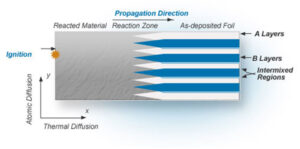
NonoBond heating process1 300x149 S Bond® Solders At the Interface of the NanoBond® Process

Figure 1. Illustration of the NanoBond® / NanoFoil® heating process® (from www.indiumcorp.com)

S-Bond active solder layers have been shown in many applications to be the key ingredient that permits many ceramics and refractory metals to be bonded to largely coefficient of thermal expansion (CTE) mismatched metals such as aluminum and copper. Indium Corporation offers a NanoBond® process that uses NanoFoil ® as local heat source to remelt preplaced solder layers without the need for the bulk heating of assembled components that have large CTE mismatch. Active S-Bond solders are applied as prelayers and have Ti, Ce, Ga and Mg additions that permit them to wet any ceramic or metal surface. Once the S-Bond pre-layers are applied to ceramic and/or metallic surfaces, conventional solders can be reflowed onto the S-Bond layer to create the preplaced solder layers that are remelted and bonded via the heat emitted from an ignited NanoFoil®. Figure 1 illustrates how temperatures of over 1,400 K are generated by an ignited nano-engineered foil.

Figure 2 illustrates the use of S-Bond in the NanoBond® process in bonding sputter targets.

s bond applied nanobond process S Bond® Solders At the Interface of the NanoBond® Process

Figure 2. An illustration of S-Bond being applied in the NanoBond® process

NanoFoil® , sold by Indium Corporation, is used on the Nanobond® process as a heat source to only locally reheat a pre-soldered interface with an instantaneous release of heat energy for joining applications. NanoFoil® is a nano-engineered material fabricated by vapor-depositing thousands of alternating nanoscale layers of Aluminum (Al) and Nickel (Ni), as shown in Figure 1. When activated by a small pulse of local energy from electrical, optical or thermal sources, the foil reacts to precisely deliver localized heat up to temperatures of 1500°C in fractions (thousandths) of a second. As a sacrificial heat source in soldering and brazing applications, NanoFoil® is ideal for high-temperature applications. NanoFoil® becomes a non-functional part of the solder or braze joint, eliminating the need for an oven or furnace and allowing for the use of higher temperature solders.

NanoFoil® works by acting as a local heat source to melt adjacent solder layers without heating the target or backing plate materials. This allows the bonding of nearly any combination of sputter target material and backing plate material, including ceramics to metals, irrespective of the difference in coefficient of thermal expansion (CTE). S-Bond solders enable the NanoBond® process in many applications by providing an “activated / bonded layer” on the ceramic or metal interface to which conventional solders can wet and adhere.

Contact us for more information on how S-Bond can assist your NanoBond® applications.

NanoFoil® and NanoBond® are registered trademarks of Indium Corporation.

S-Bond® 220M Developed for Silicon/Silicate Joining

Monday, October 10th, 2011

The direct solder joining of silicon is difficult posing solder wetting and adherence challenges for many applications including electronic “die” packages, sensor chips and solar panels. The direct solder bonding to silicon (Si) has been limited by the wetting resistance of angstrom thick nascent silicon dioxide (SiO2) layers that naturally forms on silicon. To combat these solder bonding challenges, metal plating (vapor deposition of Ti and Ni) has been used. To address this challenge, S-Bond Technologies has developed and has recently been awarded a patent for its S-Bond 220M alloy which is a Sn-Ag-Ti-Ce-Ga + Mg alloy that has been optimized for direct Si solder bonding without flux nor plating. The new alloy bonds well to silicon, silica, and glass silicates based on a solder formulation that adds magnesium (Mg) in low enough levels that does not change the solder melt behavior but enhances the “active” nature of S-Bond alloys to interact with oxides of silicon and many other metals even more effectively than other active solders. These Mg modified active solders wet and adhere very well to silicon based on mechanical activation used in other active solders.

In wetting tests the mechanism of Si adherence for S-Bond 220M was observed to be on the micro-scale, and can be seen as a metallurgical interaction on the Si surface with the Ti modified Sn-Ag phases. See the image below.

s bond reaction zone1 S Bond® 220M Developed for Silicon/Silicate Joining

In addition to direct solder bonding to Si, S-Bond 220M has been found to enhance the direct solder bonding of a wide range of metals to many ceramics, glasses and refractory metals. Due to its versatility and bonding to Si, silicates, ceramics and metals, S-Bond 220M is finding wide acceptance in solar panel manufacturing and sputter target bonding . Contact Us to discuss your needs to direct solder to silicon, silicates and other glass-ceramic-metals.

Solar Panel Assembly

Friday, July 8th, 2011

S-Bond has demonstrated the assembly (stringing) of photovoltaic (PV) solar panels bonding aluminum or copper buss bars using their active solders (S-Bond) in combination with thermosonic bonding. Thermosonic bonding is the simultaneous application of ultrasonic agitation, pressure and heat, normally applied using commercially available ultrasonic soldering irons.

Commercial polycrystalline silicon photovoltaic (PV) cells currently utilize an aluminum powder applied metallization as the current collector for the electrons released by the incident solar energy collects at the aluminized surfaces. Commercial PV cells then require that a conductor strip be bonded to the aluminized cell back in order to transmit the electrons (current) from the cell to the adjacent cells that make up a solar power module in a solar panel assembly. The challenge has been electrically bonding to the aluminized (or otherwise coated) PV materials. Many times silver paint / plated pads has been applied to the coated PV cell followed by conventional flux soldering of pre-tinned thin copper strip to the silver pad

The S-Bond active solder process eliminates the need for pre-coating of silver (lowering cost) to the coated cell surfaces and eliminates the need to use flux (lowering cleaning costs while improving the working environment with no flux off gases). The figures below show how thermosonic bonding of S-Bond coated copper (or even aluminum) buss strip can be used to “string” PV cells together into solar panel modules. S-Bond can provide S-Bond alloys tinned with Copper (or aluminum) buss using an ultrasonic solder pot as illustrated below. For aluminum powder metallized PV cells, the ultrasonic tip is used to “burnish” and densify the areas for buss strip attachment. This treatments makes a dense well adhered, directly S-Bond solderable surface. Using a heated ultrasonically activated soldering tip, the tip can be robotically manipulated to press heat and activate the S-Bond solder in order to locally reheat, reflow and mechanically disrupt the local oxides on the melting solders such that a metallurgical bond is made direct to the coated PV surfaces.

S-Bond has demonstrated this same thermosonic method for bonding to a range of different coated PV materials including Mo coated CIGS and even bonding ceramics to the back of concentrated solar PC cells (CPV’s). Contact us and see how S-Bond thermosonic boding might be used in your solar panel manufacturing processes. To see how robotics and thermosonic bonding can be integrated with robotics take a look at http://www.japanunix.co.jp/ju_en/products/video_unisonik.html .

Please Contact Us to inquire how S-Bond active solders and thermosonic bonding may be used in the manufacture your solar modules.

Pic1 Solar Panel Assembly

Pic2 Solar Panel Assembly

Pic3 Solar Panel Assembly