Posts Tagged ‘Aluminum Soldering’

S-Bond® Solders At the Interface of the NanoBond® Process

Friday, January 27th, 2012
NonoBond heating process1 300x149 S Bond® Solders At the Interface of the NanoBond® Process

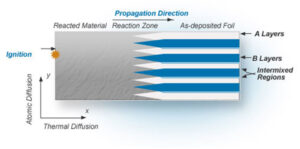
Figure 1. Illustration of the NanoBond® / NanoFoil® heating process® (from www.indiumcorp.com)

S-Bond active solder layers have been shown in many applications to be the key ingredient that permits many ceramics and refractory metals to be bonded to largely coefficient of thermal expansion (CTE) mismatched metals such as aluminum and copper. Indium Corporation offers a NanoBond® process that uses NanoFoil ® as local heat source to remelt preplaced solder layers without the need for the bulk heating of assembled components that have large CTE mismatch. Active S-Bond solders are applied as prelayers and have Ti, Ce, Ga and Mg additions that permit them to wet any ceramic or metal surface. Once the S-Bond pre-layers are applied to ceramic and/or metallic surfaces, conventional solders can be reflowed onto the S-Bond layer to create the preplaced solder layers that are remelted and bonded via the heat emitted from an ignited NanoFoil®. Figure 1 illustrates how temperatures of over 1,400 K are generated by an ignited nano-engineered foil.

Figure 2 illustrates the use of S-Bond in the NanoBond® process in bonding sputter targets.

s bond applied nanobond process S Bond® Solders At the Interface of the NanoBond® Process

Figure 2. An illustration of S-Bond being applied in the NanoBond® process

NanoFoil® , sold by Indium Corporation, is used on the Nanobond® process as a heat source to only locally reheat a pre-soldered interface with an instantaneous release of heat energy for joining applications. NanoFoil® is a nano-engineered material fabricated by vapor-depositing thousands of alternating nanoscale layers of Aluminum (Al) and Nickel (Ni), as shown in Figure 1. When activated by a small pulse of local energy from electrical, optical or thermal sources, the foil reacts to precisely deliver localized heat up to temperatures of 1500°C in fractions (thousandths) of a second. As a sacrificial heat source in soldering and brazing applications, NanoFoil® is ideal for high-temperature applications. NanoFoil® becomes a non-functional part of the solder or braze joint, eliminating the need for an oven or furnace and allowing for the use of higher temperature solders.

NanoFoil® works by acting as a local heat source to melt adjacent solder layers without heating the target or backing plate materials. This allows the bonding of nearly any combination of sputter target material and backing plate material, including ceramics to metals, irrespective of the difference in coefficient of thermal expansion (CTE). S-Bond solders enable the NanoBond® process in many applications by providing an “activated / bonded layer” on the ceramic or metal interface to which conventional solders can wet and adhere.

Contact us for more information on how S-Bond can assist your NanoBond® applications.

NanoFoil® and NanoBond® are registered trademarks of Indium Corporation.

Metal Soldering with Active Solders

Monday, October 10th, 2011

Active solders such as S-Bond have wide application in joining a wide variety of metals including aluminum, copper, stainless steel, titanium, all based on S-Bond alloys’ ability to directly wet and adhere to the metallic surface compounds. Using mechanical activation active solders such as S-Bond successfully join like and dissimilar metal combinations in a wide variety of applications, from heat sinks and sensors to medical/surgical devices.

Soldering of metals has always depended on the “disruption” of surface oxide or other compounds that naturally form on metals. These surface oxides need to be removed for molten solders to permit the liquid solder to “wet” and adhere to metallic surfaces. Thus in soldering, the major process component of soldering is removal of these compounds such that the molten solder can adhere and react with the underlying clean metal surface. In conventional soldering, chemical fluxes are used to remove surface oxides as the solder filler metals melt and flow onto to the surface the flux has just cleaned. Fluxes are nominally acids of differing activity, depending on the metals being soldered and the stability of the oxides that have formed on the metal.

Metals such as copper, nickel and iron naturally form oxides that are not as stable at the oxides that form on aluminum, stainless steel, and titanium and thus the fluxes and/or surface preparations prior to soldering differ. Copper and nickel are easily soldered with milder fluxes and/or rosins. Their oxides are easily reduced. On the other hand, aluminum, stainless steels and titanium, all known for their corrosion resistance (due to their stable surface oxides) are difficult to solder and either employ aggressive acidic fluxes or plating with either nickel or copper prior to soldering. After plating, then these corrosion resistant metals can be soldered with milder fluxes.

S-Bond’s active solders eliminate the flux requirement and the need for plating. With just mechanical activation, S-Bond alloys wet and adhere to all metals. There are two main mechanisms active solders adhere. These mechanisms are illustrated below.

active soders mechanisms Metal Soldering with Active Solders

On copper, copper alloys, aluminum and nickel metallurgical bonding occurs as the “active elements (Ti, Ce, Ga and/or Mg) interact with the base metals’ surface oxides, disrupt them and then the S-Bond elements react with the underlying metals to form intermetallic zones that provide the basis for adherence.

In more corrosion resistant alloys such as Ti and/or stainless steel S-Bond adherence is based in atomic attraction at the very local level. The surface oxide layers are not disrupted, but the “atmospheres” of the active elements in the S-Bond solders interact across the oxide layer and create attractive forces. The images below show the microstructural differences between these two “operative” S-Bond joining mechanisms. The aluminum / S-Bond image illustrates the S-Al-Ag phase that forms at the interface. The Ti / S-Bond interface shows excellent interface conformance but no resolvable reaction zone.

s bond interface adherence Metal Soldering with Active Solders
With these two metal bonding mechanisms, S-Bond active solders can join all metals with varying bond strengths. Bond lap shear strengths range from 2,000 – 8,000 psi (14-56 MPa). The bonding is metallic and offers good electrical and thermal conductivity. Another advantage of active soldering is the ability to directly solder dissimilar metals. When conventionally soldering, dissimilar metal joining presents challenges in selecting a compatible flux that can remove oxides on copper and aluminum at the same time while the solder reacts with the surface and many times only plating both sides of the joint is effective for soldering. In S-Bond active soldering the two different adhesion mechanisms operate in parallel on opposite sides of the joint, at the same time without flux, thus S-Bond is a one step process. Additionally, S-Bond joining is done at lower soldering temperatures and thus the process can mitigate the negative effects of thermal expansion mismatch when a soldered assembly cools from the soldering temperatures.

If you would like to evaluate S-Bond for your metal joining applications you may order a Test Kit or Contact Us to discuss the application and/or have us quote making prototype parts.

Soldering vs. Brazing

Friday, July 8th, 2011

We receive many inquiries to silver solder, solder or braze components and many times there is confusion over this terminology and the various materials and processes used to bond metals, ceramic and/or glasses. This short article offers some clarification to the distinctions between soldering and brazing such that you can make informed decisions about your needs.

Brazing is a process where a molten metal is the joining agent (filler) between to materials where during the bonding process only the filler metal is melted. These molten fillers react with and adhere to the adjoining surfaces. AWS (American Welding Society) defines a material to be a braze filler when it melts over 450C°C (842°F). Example braze fillers include but are not exclusive to copper, copper-silver, Cu-P, and all copper alloys, Al-Si, NiCrBSi, Ni-P, FeCrBSi, gold, silver, palladium, etc.

Soldering is a related process to brazing and also employs molten metal fillers, with the exception (according to AWS definitions) that solder fillers melt below 450°C. Such fillers include lead-tin (Pb-Sn), Sn-Ag, Sn-Bi, Sn-Sb, Zinc, Zinc-Al, etc… these solders are used in electronics, plumbing, structural low temperature components, heat sinks and cold plates, sputter targets, etc.

Note there is some confusion over the term “silver solder”… in reality silver solder is a braze but this term has been adopted commercially since the fillers use copper-silver (Cu-Ag) alloys. These silver-solders are also associated with the term “hard solder” vs. soft solder… All “silver solders” are technically brazes since their melting temperatures are over 750°C (1382°F) and employ braze processes to make bonded components.

Is soldering or brazing more suitable? …. The answer is “it depends” on…

  • Strength requirements… brazed joints can be 3 – 10x the strength of soldered joints
  • Corrosion resistance… solders are generally more susceptible to oxidation and degradation from chemicals and salt since the fillers are Sn, Zn or Pb based.
  • Temperature assemblies can be exposed to… solders melt from 100 – 250°C and are generally used in electronics and other temperature sensitive parts.
  • Thermal expansion… differing CTE assembly materials benefit from soldering since lower joining temperature lowers distortion upon cooling and “softer” filler metals permit CTE mismatch to be accommodated.
  • Cost… soldering is generally a lower cost process with the filler metals being less expensive and the lower temperatures processing reduced post joining clean-up lowers overall joining costs.

So, chose the processes and filler metals most suited to your assemblies and their expected service temperatures, remembering soldering is generally less expensive and less sensitive to thermal expansion mismatch.

When comparing soldering to brazing and their related filler alloys, one begins to see the processing changes made necessary by the significantly different processing temperatures (100 – 450°C) for solders and 450-1,600°C) for brazing. The higher temperatures needed to melt brazing fillers makes oxidation of the filler metals and the base materials (being joined) much more of a concern and problem. Since oxidation and the subsequent oxides formed interfere with wetting and adherence, oxidation must be minimized and a means to remove any formed oxides must be used. Chemical fluxes are commonly used and the most effective fluxes melt and flow just before the melting temperatures of the filler metal and are not thermally decomposed in the range of temperatures where the filler metals melt. For solder filler metals, fluxes are normally rosin based or low temperature acidic compounds that when melted can react with tin, lead, silver, copper or nickel oxides.  For brazes, fluxes are normally organometallic salts, or higher temperature salts that when melted are acid and reduce the oxides forming on materials such as brass, steel, stainless steel and even aluminum. Normally to flux the more oxidation resistant materials (stainless steel and/or aluminum) very acidic and corrosive fluoride based acid are required.  Soldering fluxes, as a result of their composition, are much less aggressive and generally less corrosive than the fluxes used in brazing.

Alternatively, brazing is also commercial done in furnaces… and those furnaces can either produce a “fluxing atmosphere” such as in cracked ammonia (reduces oxygen activity while reducing oxide scales formed in steel and copper based materials).  Other furnaces exclude oxygen altogether by pumping the atmosphere out with vacuum pumps, then backfilling with inert or reducing gases (N2, Ar, or H2) pumping to high vacuum where the high vacuum really excludes oxygen and can in many metals reduce and/or evaporate the surface oxides on part. Thus “furnace brazing” many times is a preferred method over torch brazing due to temperature uniformity and part cleanliness after brazing.

Structural soldering (non-electronic) is generally not practiced in ovens since soldering temperatures are low.  Soldering irons (hot metal tips), propane torches (in brazing MAP and even acetylene torches are used for their higher heating capacity), hot air guns and hot surface plates are used. In high volume soldering for electronics, batch or continuous flow (belt) furnaces are employed to re-flow solder pastes that consist of a decomposable organic carrier, a flux and the solder filler metal powder. When heated in a “reflow” oven, reducing gases or more inert gases such as N2 can also be used, however, if mildly acidic or no clean fluxes are uses, air solder reflow ovens can be used.

The bottom line, once you have the terminology down, is to choose the most compatible (technically and economically) filler metal (solder vs. braze) then select the most suitable process compatible with that filler metal in combination with the assemblies’ components.

Feel free to Contact Us to assist in your selection process. We can evaluate the most suitable filler metals followed by the most appropriate process.

Solar Panel Assembly

Friday, July 8th, 2011

S-Bond has demonstrated the assembly (stringing) of photovoltaic (PV) solar panels bonding aluminum or copper buss bars using their active solders (S-Bond) in combination with thermosonic bonding. Thermosonic bonding is the simultaneous application of ultrasonic agitation, pressure and heat, normally applied using commercially available ultrasonic soldering irons.

Commercial polycrystalline silicon photovoltaic (PV) cells currently utilize an aluminum powder applied metallization as the current collector for the electrons released by the incident solar energy collects at the aluminized surfaces. Commercial PV cells then require that a conductor strip be bonded to the aluminized cell back in order to transmit the electrons (current) from the cell to the adjacent cells that make up a solar power module in a solar panel assembly. The challenge has been electrically bonding to the aluminized (or otherwise coated) PV materials. Many times silver paint / plated pads has been applied to the coated PV cell followed by conventional flux soldering of pre-tinned thin copper strip to the silver pad

The S-Bond active solder process eliminates the need for pre-coating of silver (lowering cost) to the coated cell surfaces and eliminates the need to use flux (lowering cleaning costs while improving the working environment with no flux off gases). The figures below show how thermosonic bonding of S-Bond coated copper (or even aluminum) buss strip can be used to “string” PV cells together into solar panel modules. S-Bond can provide S-Bond alloys tinned with Copper (or aluminum) buss using an ultrasonic solder pot as illustrated below. For aluminum powder metallized PV cells, the ultrasonic tip is used to “burnish” and densify the areas for buss strip attachment. This treatments makes a dense well adhered, directly S-Bond solderable surface. Using a heated ultrasonically activated soldering tip, the tip can be robotically manipulated to press heat and activate the S-Bond solder in order to locally reheat, reflow and mechanically disrupt the local oxides on the melting solders such that a metallurgical bond is made direct to the coated PV surfaces.

S-Bond has demonstrated this same thermosonic method for bonding to a range of different coated PV materials including Mo coated CIGS and even bonding ceramics to the back of concentrated solar PC cells (CPV’s). Contact us and see how S-Bond thermosonic boding might be used in your solar panel manufacturing processes. To see how robotics and thermosonic bonding can be integrated with robotics take a look at http://www.japanunix.co.jp/ju_en/products/video_unisonik.html .

Please Contact Us to inquire how S-Bond active solders and thermosonic bonding may be used in the manufacture your solar modules.

Pic1 Solar Panel Assembly

Pic2 Solar Panel Assembly

Pic3 Solar Panel Assembly

Active Solder… What-Why-How

Friday, July 8th, 2011

What is meant by “active solder”?  The term evolves from active brazing; I assume that does not really help you…. But it is true that active brazing was the key technology that led to the development of active solders.

Most important in the brazing/soldering sense what does “active” really denote. By practice, active brazes and solders have elements added to their base compositions that are reactive with surface oxides and other compounds that form naturally and can, when thermally activated (heated to reaction temperatures), these reactive elements can interact and substitute themselves into the chemical structure of surface compounds (oxide layers,  solid oxides  or other ceramics) in a way that the new interface compounds form which are well bonded to the surface of a material being joined.

For example, elements such as titanium (Ti), zirconium (Zr), hafnium (Hf), vanadium (V), niobium (Nb) and tantalum (Ta) have an electronic outer shell structure that enable them to more easily react with many compounds and can thus integrate themselves (when thermally activated) into many compounds found in surface films on metals, semiconductors and ceramics. Thirty years ago or so, with the advent of vacuum metallurgy and vacuum brazing, the integration of such “reactive” elements into brazing filler metals became commercially viable. Wesgo Metals (division of Morgan Advanced Ceramics) and Degussa (now BrazeTec) pioneered such reactive element additions to braze filler metals.  These reactive metal additions to braze fillers are “active” (typically in low concentrations, 0.1 – 2 w/o) since upon melting, the elements diffuse to the braze interface and “reduce” the local oxide (or ceramic) and enter into the bonding structure. Thus the reactive elements become a “active” participant in the chemical constituency of the interface compounds that the term “active braze” stuck and these braze filler metals have been termed “active braze alloys”. Mostly Ti, Hf, Zr or V are being commercially added to Cu-Ag, Au, and Ni alloys. However due to the “activity” of these braze fillers brazing the active braze process is exclusively done high vacuum in order to exclude any oxygen or nitrogen that might react the Ti, Hf, Zr or V elements, preventing sufficient reactive element activity to diffuse and react with surface compounds.  It has also been observed that elevated temperatures, normally over 800°C, have been required to thermally activate the substitution process of the reactive elements with interface compounds in brazed assemblies in order to effect a braze joint.

The extension of “active” brazing to soldering and to be active at soldering temperatures (below 450°C) was a goal of investigators at Euromat and S-Bond Technologies. In 1996 their first “active” solders were patented. Before this time the element indium was the only active commercially available solder. Note that Ti and Hf additions had been made to Sn-Ag base solders but the soldering required heating these filler metals to over 800°C in a vacuum to get the reactive element “Ti” to react with surface compounds and bond. The discovery by S-Bond Technologies of small additions of rare earth elements (e.g. Ce, La, and Lu) gallium and titanium together in solder filler bases  (Sn-Ag, Pb-Sn, Sn-Sb, Sn-Bi, etc.) enabled the “active” soldering phenomena to occur when soldering  most metals and many ceramics at solder melting temperatures (from 115°C to 420°C). The addition of rare earth elements and gallium enabled these Ti containing “active” molten solders to wet and adhere to many metal and ceramic surfaces with using flux. A key part of active solders is that they are “self fluxing” as they are melted and bond to a wide range of base materials without the need for added chemical fluxes or plating…. A key attribute of active solders (and/or brazes).

It was found; however, that the active soldering behavior (wetting and bonding without flux) required that “mechanical activation” be used in conjunction with the active solders patented by S-Bond and Euromat. This process is a means, again without chemical fluxes, to break up the stable solder oxide film that forms when the active solders melt. With the addition of Ti and rare earth elements into Sn-Ag and other solder bases, the rare earth element modifying the melting surfaces’ oxides forming a protective layer for the molten solder, but encasing the other active elements from coming into contact with the base materials. Once the thin oxide film is broken in a continuous way, Ti, Ce and Ga interact with the base materials’ surface compound and bonds to or breaks up these compound layers. Click this link to see how active solders (S-Bond) works on aluminum to provide metallurgical bonds with the need for aggressive chemical fluxes.

So for active solders…

The What: Solders that when melted can wet and adhere to metals, ceramics and glasses without the use of chemical fluxes

The Why: To join at soldering temperatures, without flux and eliminate contamination and entrapment associated with flux usage. Also is enables solder joining of metals, ceramics, carbon/carbides

The How: With Ti, rare earth and gallium additions, many solder bases can be made “active” provided the active solder compositions are used in conjunction with mechanical activation that effectively disrupts the oxide films that form constantly on molten active solders.

If you have further questions about active solders and would like to know more about how they could benefit the assembly of your components [flux free and no plating] then Contact Us.

Can S-Bond Soldered Joints be Coated ?

Monday, May 16th, 2011

Many times our customers have to coat assemblies operations after aluminum bonding, graphite bonding, ceramic to metal bonding, etc; this can present certain challenges that one should be aware of since soldered joints. Unlike welded and many brazed joints, soldered joints utilize a significantly different filler metal. In the case of S-Bond solders, Sn-Ag is the common base filler that is used in aluminum bonding as well as copper, steel, stainless steel, refractory metals, and titanium and many other metals. As such, then the properties of the joint MUST be considered when coating.

The range of coatings seen in industry vary widely, but they can be put in several categories, these are overlay, diffusion or chemical conversion coatings. The overlay coating is the most commonly used in industry. Overlay coating is as it states, it is a coating placed over the base materials and thus over the joint on bonded assemblies (ie. aluminum bonding, graphite bonding, ceramic to metal bonding).

Such overlay coatings include:

  • Electroplate
  • Powder coat
  • Paint
  • Thermal Spray
  • Vapor deposition (evaporative, sputtering or chemical decomposition)

With the exception of electroplate, S-Bond solder joints are compatible with these processes on the provision the part temperature in the coating process does not exceed the remelt temperature of the S-Bond (solder) joint, in the range of 180 – 450C, depending in the solder alloy used. Electroplate coatings can be made over solder joints as long as the preparation of surfaces for electroplate ( many times acid etching is used) does not preferentially attack the solders significantly faster that the surrounding base materials, recognizing that thin joints of less “noble” metals (Sn, Zn, etc.) adjacent more noble metals like aluminum, stainless steel, nickel alloys (platinum being one of the most noble) can set up an galvanic corrosion cell as illustrated in Figure 1.

corrosion cell flow 1 Can S Bond Soldered Joints be Coated ?

Figure 1

This situation can arise in service, in a plating or in an acid cleaning bath and can be managed paying attention to the time or acid activity in order to prevent excessive chemical attack (corrosion reaction) with the solder interface. S-Bond joints between aluminum, copper and a wide range of metals has been successfully electroplated, once the plater pays attention to the dissimilar metal combination a soldered assembly presents.

The other set of coating technologies that can be applied to bonded assemblies are the conversion coatings… of which two common industrial coatings for aluminum include chromate coating or anodizing. Anodizing is an electrolytic passivation process used to increase the thickness of the natural oxide layer on the surface of aluminum parts. The process is called “anodizing” because the part to be treated forms the anode electrode of an electrical circuit. Anodizing increases corrosion resistance and wear resistance. Anodic films are most commonly applied to protect aluminum alloys, although processes also exist for titanium, zinc, magnesium, niobium, and tantalum. Chromate conversion coatings are a type of conversion coating used to passivate aluminum, zinc, cadmium, copper, silver, magnesium, and tin alloys and is primarily used as a corrosion inhibitor. The process is named after the chromate found in the chromic acid used in the bath, more commonly known as hexavalent chromium.

NOTE: S-Bond bonded assemblies CANNOT be anodized since this chemical conversion process includes the use of very aggressive acids and depends on the base aluminum to chemically convert to Al2O3 (aluminum oxide) … in the area of joint where S-Bond would be exposed to the chemical conversion acidic bath, the Sn-Ag would be aggressively attached and furthermore the lack of aluminum locally would not enable to support the conversion to the anodized Al2O3 coating, thus providing a local spot for corrosion.

On the other hand S-Bond joined parts are compatible with chromate conversion coating as long as the pre-cleaning steps to not expose the S-Bond solder interface to a long duration acid dip where the Sn-Ag interface is attached preferentially. The chromate coating will take to the S-Bond layer and provide corrosion protection for the S-Bond filler metal, thus protecting the whole assembly.

Diffusion coatings such as carburizing, nitriding or aluminizing are thermally activated coating processes where higher concentrations of the coating elements (C, N2 or Al) are diffused from vapor, liquids or solids rich in those elements into the base metals. These processes generally occur above 800°C, well above the S-Bond remelt temperatures so they would not be compatible with S-Bond joined assemblies.

In summary; S-Bond is compatible with many overlay and some selected conversion coatings. We recommend the following post bond assembly coating processes… chose the ones that provide the type of protection required:

  • Powder coatings
  • Painting
  • Ni, Au, Sn, Zn Electroplates (provided acid cleaning is controlled)
  • Chromate conversion coatings
  • Vapor deposited coatings (provided assembly remains below (250°C)

Please Contact Us, if there are questions on coating your bonded assemblies.

Sapphire Window Sealing with S-Bond®

Monday, May 16th, 2011

S-Bond® active solder enables the joining of sapphire to metals and provides an alternative to other sealing processes. S-Bond joining of sapphire/metal seals is proving to be a more robust and reworkable joining process while being simpler than many of the existing sapphire widow sealing processes, as this article presents.

Sapphire bonding for window joining normally is done by either active brazing at elevated temperatures in high vacuum or by soldering and or brazing after metallization. Active brazing is limited by the need to match CTE between the metal and the sapphire since the joining temperatures occur above 800°C. Conventional brazing or soldering (non-active) is done after a multi-step pre-metallization process on the sapphire. Two pre-metallization steps are offered commercially. One is physical vapor deposition of a thin Ti layer then a Cr layer followed by Ni-electroplate. The other commercial pre-metallization technique is a thermally activated diffusion / chemical conversion process in wet H2 called the Mo-Mn process where Mo, MoO3, Mn and MnO2 react to form an oxide/metal composite which binds to the sapphire surface. This reacted glass-metal layer is then nickel plated to form a brazeable or solderable layer.

S-Bond® sapphire window sealing has emerged as a simpler soldering process with only two-steps. S-Bond joining centers around using “active” solder alloys with titanium and cerium added to Sn-Ag, Sn-In-Ag, and Sn-Bi base alloys. These active solders are able to be reacted directly with sapphire surfaces prior to bonding.

The joints produced are:

  • Hermetic, passing < 10-9 atm-cc/ sec
  • Strong (> 5,000 psi shear)
  • Ductile, based on using Sn-Ag or Sn-In base alloys

The joining process starts with an S-Bond metallization process which is thermally activated using a proprietary process to prepare the sapphire surfaces to develop a chemical bond to the sapphire surface through reactions of the active elements in S-Bond alloy and sapphire (Al2O3 single crystal). This process starts with an elevated temperature treatment in a protective atmosphere furnace with S-Bond alloy placed on the sapphire surfaces to be joined. At the elevated temperatures, the active elements in S-Bond react with the sapphire to form a chemical bond. This chemical bond and the S-Bond layer in a subsequent joining step provides a much higher level of joint strength and creates high performance ceramic-metal joints.

Figure 1 are images of a sapphire window after pre-metallization steps on the edge of a sapphire window. Figures 2 shows the metallographic cross section of the sapphire where the S-Bond layer is reacted and adhered to the sapphire surface. The S-Bond layer has been reacted at elevated temperatures in a protective atmosphere to preserve the active elements in the S-Bond. Upon cooling and removal from the furnace, the part looks like the top image in Figure 1. The sapphire window is reheated ant the scaly excess layer is removed on the sapphire window edge to leave a smooth fresh, solderable layer as seen in the bottom image in Figure 1. This is done before assembling the window into the S-Bond tinned metal frame, tube or other type of enclosure.

Figure 1 242x300 Sapphire Window Sealing with S Bond®

Figure 1

Figure 2 243x300 Sapphire Window Sealing with S Bond®

Figure 2

To prepare the metal seal area for sapphire window assembly and bonding, the metal frame, tube or enclosure is heated and a layer of S-Bond alloy is melted and rubbed, brushed or otherwise mechanically activated to form and a thin layer of the S-Bond wetted and adhered to the metal sealing surfaces.

After both sealing surfaces are S-Bond “pre-tinned”, they are re-heated and fresh thicker layer of melted S-Bond is added to the metal joint side faying surface as the pre-tinned and heated window is placed into the sealing area and oscillated or rotated to slide the two S-Bond solder surfaces past one another to disrupt the thin oxide skin that forms on the S-Bond when heated in air. After the window and metal enclosure is oscillated it is positioned, and as needed extra solder is fed into any gaps in the seal to complete the joint before it is cooled to solidify the solder.

After cooling, the S-Bond joint can be machined or cut to remove excess solder and finish the joint to meet specifications. Note that S-Bond joining does not use chemical fluxes that must be cleaned up or could etch metallic components, leaving cosmetic defects.

S-Bond alloys produce reliable joints with all metals…including steel, stainless steels, titanium, nickel alloys, copper and aluminum alloys. The bonding is accomplished…

  • Directly without the use flux.
  • Without pre-plating steps, eliminating multiple step coating processes.
  • At temperatures below 400ºC, preventing distortion and softening of metals and preventing sapphire fracture.

Examples of S-Bond Joined Sapphire Window Components

Figure 3 300x104 Sapphire Window Sealing with S Bond®

Sapphire-Metal Window Assemblies

Figure 4.1 300x225 Sapphire Window Sealing with S Bond®

Detector Housing-Sapphire to Ti

S-Bond joint shear strengths, using the elevated temperature S-Bond metallization procedure exceed 7,000 psi and are resistant to thermal cycling from -50 – 150ºC.

In summary, S-Bond® joining:

  • Has fewer process steps than other sapphire joining procedures.
  • Eliminates multiple- step metallization.
  • Lowers joining temperatures compared to conventional active brazing.
  • Permits larger and more complex assemblies to be fabricated without sapphire cracking.
  • Increases process yields related to joint failures from poor metallization layers.
  • Lowers joining costs with reduced steps
  • Eliminates clean-up of flux residue
  • Produces a reworkable joint that can be taken apart and reliably joined again

S-Bond Technologies has extensive experience in making sapphire window-metal seals with a robust high yield process. Please Contact Us so we can see how S-Bond can meet your sapphire window / metal sealing requirements.

Graphite / Carbon Joined to Metals with S-Bond®

Monday, May 16th, 2011

S-Bond® active solders enable graphite bonding and the joining of other carbon or carbide based materials to each other and to most metals within the constraints of thermal expansion mismatch. S-Bond alloys have active elements such as titanium and cerium added to Sn-Ag, Sn-In-Ag, and Sn-Bi alloys to create a solder that can be reacted directly with the carbon surfaces prior to bonding using specialized S-Bond treatments prior to solder joining. Reliable joints have been made between graphite and carbon based materials with all metals including steel, stainless steels, titanium, nickel alloys, copper and aluminum alloys…

The joints produced:

  • Are ductile, based on Sn-Ag or Sn-In alloys
  • Exceeds the strength of carbon and graphite
  • Are thermally conductive, with S-Bond alloys having k = 50 W/(m-K)
  • Are metallic and this electrically conductive with a metallurgical bond

S-Bond alloys has been shown to wet and adhere to a wide variety of the graphite and carbon, including:

  • All Grades of Graphite
  • Metal infiltrated graphite
  • Graphite and Carbon Foams
  • Pyrolytic Graphite
  • High conductivity graphite fibers
  • Diamond

S-Bond graphite bonding and joining to carbon based materials is thermally activated using S-Bond Technologies proprietary process, which prepares the graphite-carbon surfaces and develops a chemical bond to the surface, through reactions of the active elements in S-Bond alloy. These joints start with processing the graphite/carbon surfaces at elevated temperatures in a protective atmosphere furnace with S-Bond alloy placed on the graphite-carbon surfaces to be joined. At these elevated temperatures, the active elements in S-Bond (Ti, Ce, etc.) react with the ceramic to develop a chemical bond, as shown in the Figure 1.

Figure 2 shows the actual interaction of the S-Bond layers to the underlying graphite in graphite bonding. The chemical bond forms TiC based and the S-Bond layer in a subsequent joining step provides a much higher level of joint strength and creates high performance joints. After pretreatment with S-Bond alloy, the re-heated graphite or carbon can be joined to aluminum face sheets or other types of metals and composites.

Figure Gr 1 BondingIllustration Graphite 300x73 Graphite / Carbon Joined to Metals with S Bond®

Figure 1

Figure Gr 2 Gr FoamBondMetallography2 300x240 Graphite / Carbon Joined to Metals with S Bond®

Figure 2

S-Bond graphite bonding processes have been developed that can adhere to graphite foam materials and to solid graphite. Examples of the interfaces are shown in Figure 3. The metallurgical bond and the mechanical bond work well for Gr-Foam as the structure in Figure 3 illustrates.

Figure Gr 3 Gr FoamBondMetallography 300x225 Graphite / Carbon Joined to Metals with S Bond®

Figure 3

S-Bond alloys wet and encapsulate the Gr-foam webs, leading to adherence and gripping around the Gr-foam webs, thus creating strong and thermally conductive joints. S-Bond joining has been shown to be an effective and promising method for joining highly conductive graphite foams to metallic and composite face sheets. Joint strengths, tested in double lap shear, far exceeded the strength of the Gr-foams themselves [over 2 MPa] and after 100 thermal cycles, cycling from –50 to 150C, the joint strengths did not decrease.

Thermal properties (heat transfer coefficients in closed loop water) were measured and showed the S-Bond joined Gr-foam samples had superior heat transfer coefficients compared to commercial aluminum fin-plate heat exchangers, which have heat transfer coefficients between 10,000 and 20,000 W/m2K, compared to 500 – 1200 W/m2K for commercial aluminum fin-plate designs. These results have clearly demonstrated that S-Bond joining, in combination with Gr-foam have significantly enhanced the performance of Gr-cored thermal management devices, increasing their cooling power, lowering weight and decreasing their size. The design flexibility that S-Bond joined Gr-Foam materials allow may radically change future shapes, sizes and locations of thermal management systems.

Applications
Graphite and carbon based materials are normally used in thermal management or electrical connections or sensors and are used for their high electrical and thermal conductivity, and low friction properties. They find application in electrical sensors, power leads and feed throughs, and motor brushes. Metal conductor leads need to be attached and many times the attachment has been mechanical staking or epoxy. S-Bond joining creates a metallurgical bonded solder connection, creating much lower profile electrical connections, especially useful for small sensors and brushes.

Gr-Foams and graphite bonding offer revolutionary advancements in thermal management. Graphite foams, graphite fibers and pyrolytic graphite can all be joined using S-Bond processes. Examples of applications and components are shown below. S-Bond joints have been proven to be thermally conductive and enhance the performance of graphite based thermal management devices, especially those made from graphitic foams.

Figures 4 – 7 illustrate graphite cored heat spreader, large electrical carbon brush assemblies and small graphite electrodes for sensors along with the graphite/S-Bond interface on the tip of the electrode pin.

Figure Gr 4 Al Gr core heat spreader 300x224 Graphite / Carbon Joined to Metals with S Bond®

Figure 4

Figure GR 5 Al Gr bussbar 300x91 Graphite / Carbon Joined to Metals with S Bond®

Figure 5

Figure Gr 6 Gr Sensor 300x225 Graphite / Carbon Joined to Metals with S Bond®

Figure 6

Figure Gr 7 Gr pinMetallography 300x277 Graphite / Carbon Joined to Metals with S Bond®

Figure 7

S-Bond Technologies has developed extensive experience in active, S-Bond solder joining graphite, carbon and carbide to metals. Contact us to evaluate our joining solutions for your graphite bonding and carbon joining applications.

Aluminum Bonding with Active Solders

Monday, May 16th, 2011

Active solder, S-Bond® alloys have been developed to bond to a range of metals, ceramics and composite materials without the need for fluxes of preplating. In particular, such active solder alloys have an affinity for joining aluminum to itself and other metals and ceramics. Aluminum soldering has gotten simpler with the emergence of such S-Bond® solders. Just melt the S-Bond filler metals, mechanically spread them on the surface via brushing, rubbing, or via ultrasonically activated spreaders and the alloys will wet, adhere and provide a base for bonding. In a subsequent step, when two molten pre-tinned S-Bond layers are pressed or slid together the S-Bond layers will activate a strong solder bond.

Advantages of S-Bond Aluminum Soldering
• Lower temperature bonding (from 120 – 250°C) lowers thermal expansion mismatch issues.
• Permits the joining of aluminum to copper and other metals and ceramics, provided thermal expansion mismatch is managed in the component design.
• An S-Bond ( solder) metallic joint provide thermally conductive bonded interfaces
• No additional metal plating is required to prepare aluminum surfaces is needed, lowering preparation costs.
• Flux free joining assures nearly 100% bond areas and eliminates aggressive acid fluxes and creates cleaner work environments.
• Eliminates post bond cleaning to remove flux and associated waste water.
• Joints offer repair and re-manufacture since solders remelt at temperatures much below aluminum melting temperatures.

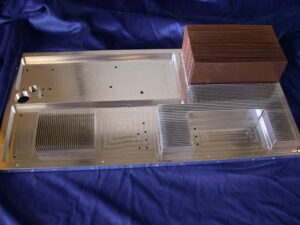
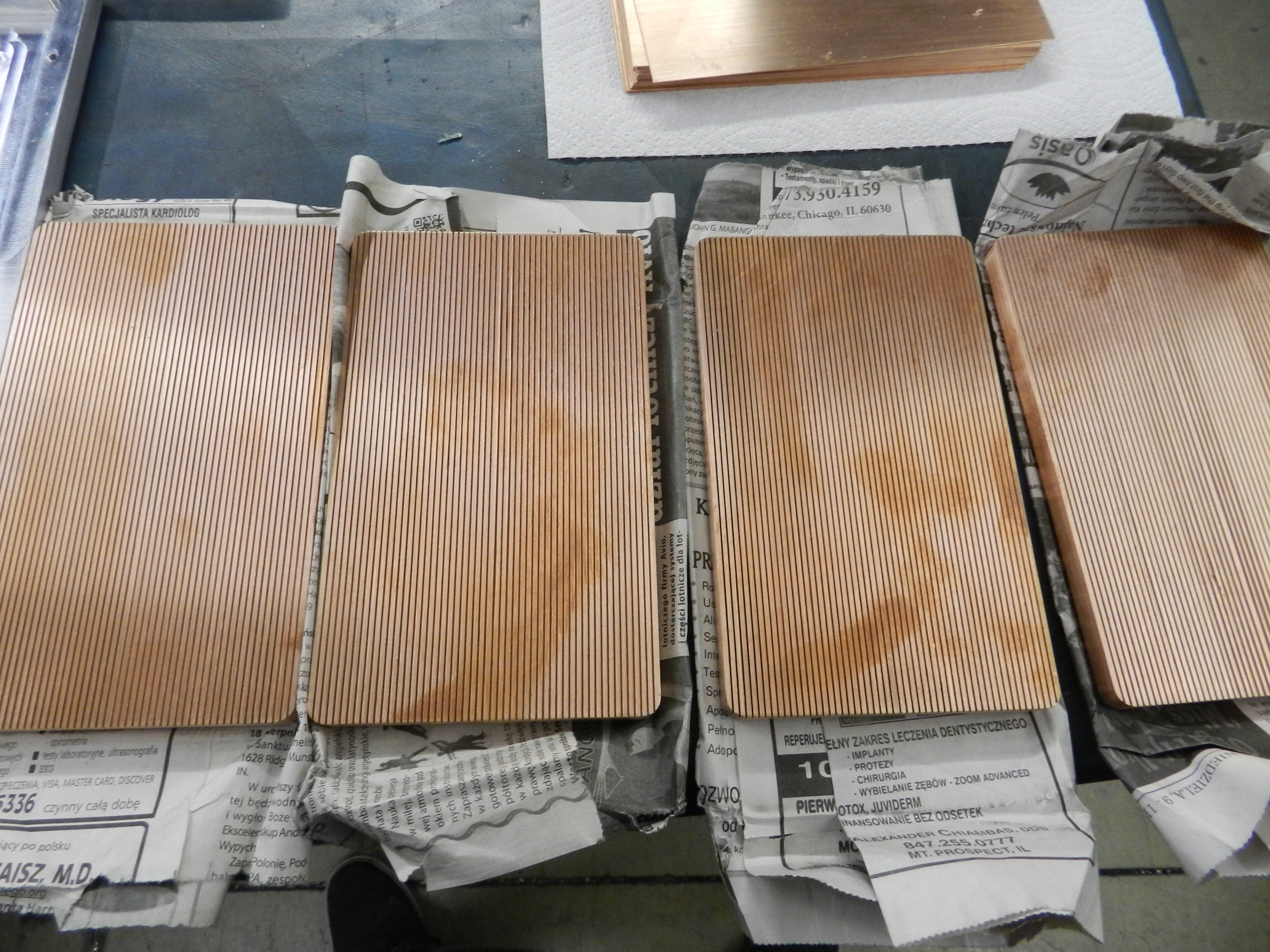
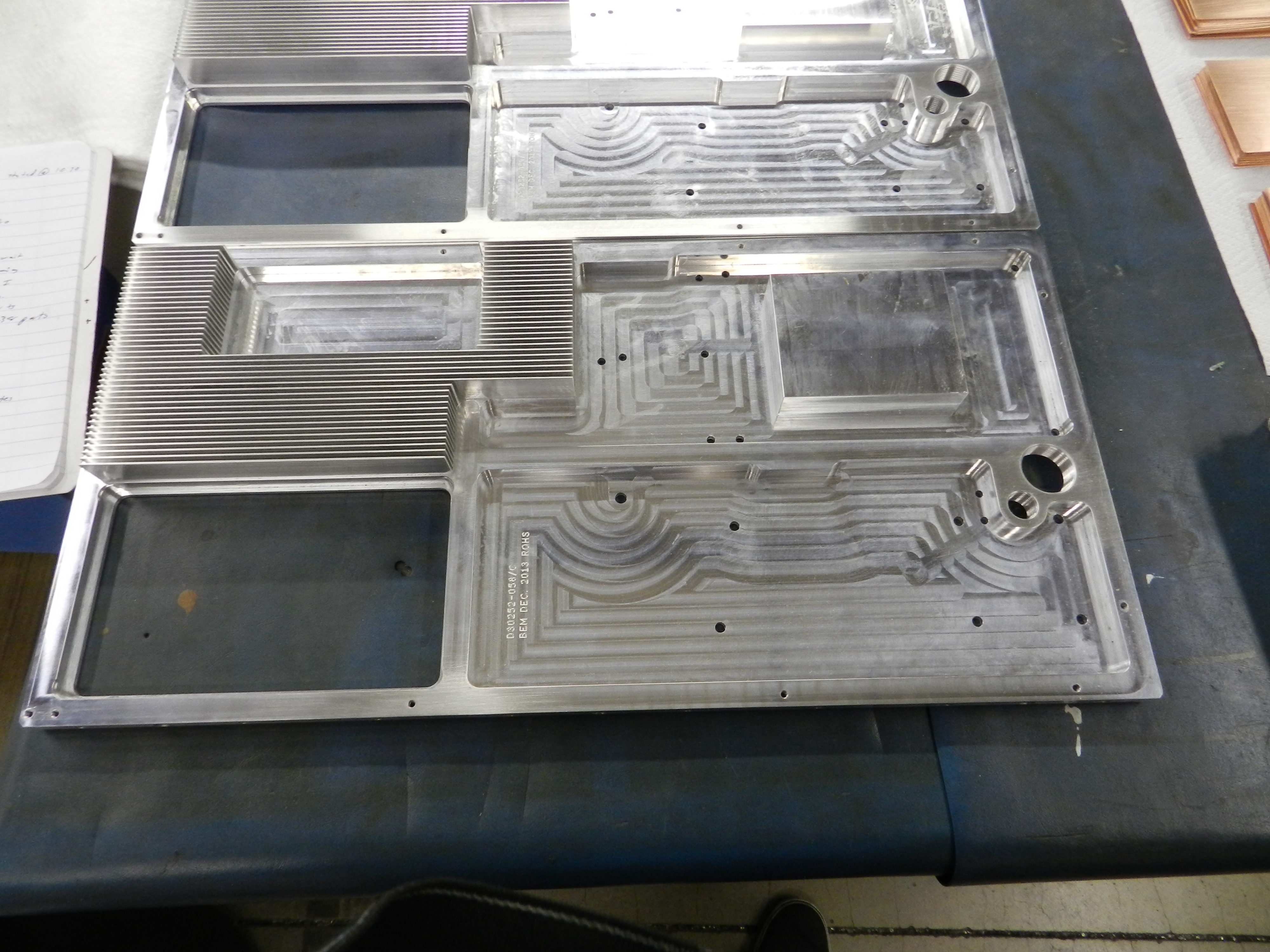
Applications where S-Bond shows its advantages include a wide range of thermal management components (finned heat exchangers, cold plates, and heat spreaders). Figures 1 – 4 illustrates just some of the many successful examples.

Figure 1 Al Gr Core Heatspreader 300x225 Aluminum Bonding with Active Solders

Figure 1

Figure 2 Al Al hx Aluminum Bonding with Active Solders

Figure2

Figure 3 FinHxAl Cu Aluminum Bonding with Active Solders

Figure 3

Figure 4 Al Heat coooler 300x225 Aluminum Bonding with Active Solders

Figure 4

Figure 5 and 6 illustrates typical S-Bond filler application methods for preparing to bond aluminum. The figures illustrate that rubbing and/or brushing can be used to spread and wet S-Bond to aluminum surfaces.

Figure 5 rubbing S Bond 300x225 Aluminum Bonding with Active Solders

Figure 5

Figure 6 Brushing S Bond 300x225 Aluminum Bonding with Active Solders

Figure 6

Aluminum soldering presents a challenge since the corrosion resistance of aluminum depends on aluminum’s naturally forming oxide (Al2O3) skin. This “nascent” oxide skin exists and reforms on all aluminum alloys and is a natural barrier to corrosion and also to metallic bonding. Soldering, brazing and even welding all must have means to either disrupt this thin aluminum oxide skin before wetting and metallurgical adherence can be generated. In welding A/C high frequency pulses on a DC arc will alternate polarity and disrupt and clean the aluminum as it welds. In brazing, chemical fluxes (fluoride base acids) as spray on or in surfaces of immersion dip brazing baths, fluxing in controlled atmospheres, or vacuum brazing (with Mg present) is used to disrupt aluminum oxide layers just prior to the molten aluminum braze filler flowing on the cleaned joint surfaces.

In aluminum soldering, the lowest temperature for the metallic joining process is (150 – 450°C), either very aggressive fluoride base acidic fluxes are used to disrupt the oxide as the solder wets and adheres to the freshly clean aluminum surface. Alternatively, nickel plate is applied to cover the oxide skin with a metallic layer that has a less stable oxide which can be disrupted with less aggressive fluxes and the molten solder can subsequently wet, flow and adhere to the nickel plated surface.

Patented S-Bond® active solder fillers that have been formulated using active element such as Ti, Mg, rare earth metals, and/or gallium to Sn, SnAl, SnZn, Sn-Ag, SnAgBi, SnAgIn or even PbSn base solders. These solders are then active enough to react with and through the aluminum’s oxide layers and react with the underlying “fresh” aluminum surface to form reaction zones which are the basis of forming strong chemical bonds with the aluminum surfaces. Figure 7 illustrates those type bonds and Figure 8 shows an actual metallographic image of an aluminum / S-Bond interface showing a reaction bond zone where Al-Ag phases have chemically formed.

Figure 7 AluminumMetallurgicalBondIllustraion 300x72 Aluminum Bonding with Active Solders

Figure 7

Figure 8 Al S BondMetallography Aluminum Bonding with Active Solders

Figure 8

Highly active S-Bond active solders do require additional “mechanical activation” as shown in Figures 1 and 2. Such mechanical means of spreading the alloy disrupts the natural oxides that form on the molten S-Bond layer. The oxides that form on Sn-Ag-Ti + Ce S-Bond alloys as they melt are cerium oxide modified films which are more tenacious/stable than the tin oxides that normally would form on molten Sn-Ag solders.

So, S-Bond alloys are a new class of solder filler metal, but also they also require new processing methods for effective aluminum soldering. The processes all involve mechanical “activation” or agitation of the S-Bond filler layers as they are pre-placed on the aluminum surfaces and the molten S-Bond layers are subsequently joined to each other to complete the bonded surface. Figure 9 illustrates ultrasonic spreading of the molten active solders onto large aluminum surfaces prior to the molten surface being placed against one another. Figure 10 shows the placement of two S-Bond “pre-tinned” molten surfaces over one another by sliding, to eliminate air from a large interface that required no voids to maintain low thermal resistance since it was a heat exchange plate for cooling automotive electronics.

Figure 9 USWetting 227x300 Aluminum Bonding with Active Solders

Figure 9

Figure 10 Al sliding of part 300x225 Aluminum Bonding with Active Solders

Figure 10

An important note: S-Bond alloys will not “reflow” or flow via capillary action into joints or flow over surfaces that have not been “pre-tinned” using mechanical activation means. Therefore, different solder joining techniques that incorporate mechanical disruption must be incorporated into S-Bond aluminum bonding processes. At first glance this behavior of S-Bond appears a limitation, BUT on the other hand a molten solder that will not flow into adjacent surfaces can be a major advantage in joining enclosures, metallic foams and intricate surfaces where excess solder flow can is not desired. A major advantage: S-Bond “stays where it is placed”…

S-Bond aluminum soldering really shows its value when…
• Thermally conductive, low void joints are needed
• Fluxing causes contamination
• Excess solder flow affects part function
• Dissimilar materials are being joined
• Reworkable joints are preferred
• Higher joint strengths are not required.

S-Bond Technologies has extensive experience in joining of aluminum in a wide range of applications and industries, please contact us to inquire how our S-Bond technology and experience can assist you with your applications.

Mechanical Activation of Active Solders

Wednesday, April 6th, 2011

Mechanical vs Chemical Fluxing During Solder Bonding

Flux is derived from Latin word fluxus meaning “flow.” In solder joining (also  aluminum soldering, graphite bonding, ceramic to metal brazing, etc.), a flux facilitates wetting by molten metals disrupting oxides on metal surfaces which interrupt the reaction/interaction of the molten solder metals with the underlying metal. Additionally, flux allows solder to flow easily on the working piece rather than forming beads as it would otherwise.

In conventional soldering, like aluminum soldering for example, the fluxes used are chemical based cleaning agents that facilitate soldering, by removing oxidation layers from the metals that are being joined. Flux is nearly inert at room temperature, but becomes strongly reducing at elevated temperatures, preventing the formation of metal oxides. Common fluxes are: ammonium chloride or rosin for soldering tin; hydrochloric acid and zinc chloride for soldering galvanized iron (and other zinc surfaces); and borax for brazing or braze-welding ferrous metals. These chemicals are quite corrosive and must be removed or neutralized before a soldered assembly is put in services. Another primary purpose of flux is to prevent oxidation of the base and filler materials. Tin-lead solder (e.g.) attaches very well to copper, but poorly to the various oxides of copper, which form quickly at soldering temperatures.

S-Bond solders are active (with their additions of reactive elements such as Ti and rare earths) and do not require chemical fluxes, in fact the S-Bond bonding processes are “fluxless” since they do not require a chemical fluxing agent to remove oxides off of metals. Since there are no chemical fluxes used, when S-Bond solder bonding the oxides on the surface of melting pools, S-Bond fillers have to be disrupted to enable the active elements to come in contact with the underlying base layers. If the oxide layer formed on molten S-Bond is sufficiently disrupted via mechanical rubbing, brushing or even ultrasonics, then S-Bond will wet and flow over metal, ceramic and carbide materials, setting up the first physical step of solder joining — wetting. [NOTE: S-Bond solder is incompatible with chemical fluxes and they should not be used in combination with S-Bond]. The figures below indicate the disruption of the transparent and thin (~ 20-30 Å) stable rare earth oxide films that form on melting S-Bond.

image 1 Mechanical Activation of Active Solders

image2 Mechanical Activation of Active Solders

Active S-Bond solders DO NOT require chemical fluxing, they require mechanically activated “fluxing” to get these active titanium and rare earth activated solders to flow and wet base materials. Hence our use of the term “mechanically activated” solders.

S-Bond can be made to wet and spread on most metals, glasses and ceramic materials via mechanical activated processes like those seen in the images below. These methods are all applicable to spread/wet and activate molten S-Bond (heated to its molten temperature) such that it bonds to metals, ceramics and glass. The images show rubbing using a spatula or other dull-heated metal edge brushing with heated metal bristles, or ultrasonic activated tools which through cavitations, disrupt.

image31 300x221 Mechanical Activation of Active Solders

Mechanical Rubbing

image42 300x245 Mechanical Activation of Active Solders

Ultrasonic Pressing

image5 Mechanical Activation of Active Solders

Mechanical Brushing

image6 300x177 Mechanical Activation of Active Solders

Ultrasonic Soldering Iron

image7 224x300 Mechanical Activation of Active Solders

Ultrasonic Solder Spreading

Mechanical activation is different from conventional soldering that it uses chemical fluxing to activate the solder bonding process. Such mechanical activation limits S-Bond soldering and precludes it as a commercial solder “reflow” process that uses preplaced solder preforms or paste that integrate chemical fluxes. The added step of mechanical disruption in mechanical activation of S-Bond’s active solders requires a pre-placement of S-Bond as a tinned layer on a heated base surface via pre-tinning by brushing, rubbing or ultrasonic spreading, prior to assembly. Once the layers are preplaced, joining of S-Bond tinned surfaces is facilitated by sliding or rotating the two facing surfaces against one another, or as the images above illustrate, the firing of focused ultrasonic energy through the molten solder interface in order to disrupt the thin rare earth oxide layer surfaces formed on the free S-Bond surfaces.

So, the S-Bond “mechanical activated” process is different than conventional reflow. A negative is high volume production — it certainly is a change that needs to be integrated into production planning since large past investments in reflow processes may negate the advantage of “fluxless” joining. However, despite the differences mechanical activation cause, in many cases active, fluxless S-Bond joining has the advantages of:

1)     Elimination of post solder cleaning, an in blind enclosures this is a huge advantage since trapped flux can contaminate optics and electronics.

2)     S-Bond solders do not flow regularly without activation, S-Bond solders stay where placed, so solders do not flow extensively to adjacent areas

3)     S-Bond solders only adhere to surfaces that have been mechanically activated, therefore any inadvertent flow and contact of excess S-Bond solders can easily be cleaned after bonding is completed.

Please contact us to further discuss how mechanical activated S-Bond joining can be implemented on your assemblies and how your bonded assemblies can benefit from active S-Bond solder joining.