Archive for January, 2012

S-Bond® Solders At the Interface of the NanoBond® Process
Friday, January 27th, 2012
NonoBond heating process1 300x149 S Bond® Solders At the Interface of the NanoBond® Process

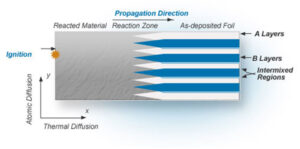
Figure 1. Illustration of the NanoBond® / NanoFoil® heating process® (from www.indiumcorp.com)

S-Bond active solder layers have been shown in many applications to be the key ingredient that permits many ceramics and refractory metals to be bonded to largely coefficient of thermal expansion (CTE) mismatched metals such as aluminum and copper. Indium Corporation offers a NanoBond® process that uses NanoFoil ® as local heat source to remelt preplaced solder layers without the need for the bulk heating of assembled components that have large CTE mismatch. Active S-Bond solders are applied as prelayers and have Ti, Ce, Ga and Mg additions that permit them to wet any ceramic or metal surface. Once the S-Bond pre-layers are applied to ceramic and/or metallic surfaces, conventional solders can be reflowed onto the S-Bond layer to create the preplaced solder layers that are remelted and bonded via the heat emitted from an ignited NanoFoil®. Figure 1 illustrates how temperatures of over 1,400 K are generated by an ignited nano-engineered foil.

Figure 2 illustrates the use of S-Bond in the NanoBond® process in bonding sputter targets.

s bond applied nanobond process S Bond® Solders At the Interface of the NanoBond® Process

Figure 2. An illustration of S-Bond being applied in the NanoBond® process

NanoFoil® , sold by Indium Corporation, is used on the Nanobond® process as a heat source to only locally reheat a pre-soldered interface with an instantaneous release of heat energy for joining applications. NanoFoil® is a nano-engineered material fabricated by vapor-depositing thousands of alternating nanoscale layers of Aluminum (Al) and Nickel (Ni), as shown in Figure 1. When activated by a small pulse of local energy from electrical, optical or thermal sources, the foil reacts to precisely deliver localized heat up to temperatures of 1500°C in fractions (thousandths) of a second. As a sacrificial heat source in soldering and brazing applications, NanoFoil® is ideal for high-temperature applications. NanoFoil® becomes a non-functional part of the solder or braze joint, eliminating the need for an oven or furnace and allowing for the use of higher temperature solders.

NanoFoil® works by acting as a local heat source to melt adjacent solder layers without heating the target or backing plate materials. This allows the bonding of nearly any combination of sputter target material and backing plate material, including ceramics to metals, irrespective of the difference in coefficient of thermal expansion (CTE). S-Bond solders enable the NanoBond® process in many applications by providing an “activated / bonded layer” on the ceramic or metal interface to which conventional solders can wet and adhere.

Contact us for more information on how S-Bond can assist your NanoBond® applications.

NanoFoil® and NanoBond® are registered trademarks of Indium Corporation.

S-Bond Joining of High Brightness LEDs

Friday, January 27th, 2012

S-Bond active solder joining is emerging as an effective method to bond heat sinks to the back of High Brightness Light Emitting Diodes (HBLEDs). Active solders can wet and adhere to many of the thermally conductive ceramics (AlN, BeO, etc.) that are being used in HBLED’s and enable effective and thermally stable and conductive joints.

schematic hbled heat sink 300x170 S Bond Joining of High Brightness LEDs

Figure 1. Shcematic of HBLED with Heat Sink

Light-emitting diodes (LEDs) are semiconductor light sources used as indicator lamps in many devices and are increasingly used for lighting. LEDs were introduced as a practical electronic components in 1962 and now many versions are available across the visible, ultraviolet, and infrared wavelengths, and with very high brightness.

LEDs are created by depositing two thin layers of materials onto a substrate, one with an excess of electrons and the other having “holes” and needing electrons to achieve a more stable state. When a potential is applied across the device, the electrons and holes move in the opposite directions. This causes light to be emitted with a wavelength and color determined by the energy released when the electrons and holes combine.

High-brightness LEDs (HBLED) are a more recent development made possible by special deposition techniques. Such HBLEBs can be driven at currents from hundreds of mA to more than an ampere, compared with the tens of mA for regular LEDs. Some can emit over a thousand lumens. Since overheating is destructive, the HBLEDs must be mounted on heat sinks to allow for heat dissipation and to prevent device failure. See Figure 1 above that shows the elements on a HBLED.

hbled S Bond Joining of High Brightness LEDs

Figure 2. Picture of HBLED

One HBLED can now replace an incandescent bulb in a flashlight, or be set in an array to form a powerful LED lamp. This opens up many new applications such as backlighting for displays, automotive lighting and new consumer products like flash for camera phones or compact projectors.

With the growing application of HBLED’s, the need for effective heat sink to device bonding increases. S-Bond active soldering processes offer one step, fluxless joining of these components without the need to preplate the ceramic with Ti, Ni, and/or Au. S-Bond can join directly to ceramics such as AlN and BeO heat sink substrates and then bond these heat sinks to copper and aluminum heat spreaders as indicated in Figure 2.

Contact us to see how S-Bond can be a solution for your HBLED joining requirements

Fluxless Soldering of Sputter Targets

Friday, January 27th, 2012
schematic sputtering process Fluxless Soldering of Sputter Targets

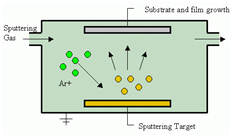
Figure 1. Schematic of sputtering process

S-Bond soldering is seeing increased application for the solder bonding of sputter targets. Sputter targets are used in a wide range of applications for making thing films used in making electronic chips, solar cells, sensors, TV screens, optical components, electrical devices, and on and on… Sputter targets support a very large physical vapor deposition (PVD) and diverse technological base that is wide ranging and pervasive. Sputter targets under ion bombardment release target material atoms into a high vacuum chamber that under an electric field can be accelerated and deposited onto the component surface where the arriving atoms arrange themselves into a contiguous thin film. Figure 1 schematically illustrates the sputtering process. Ion bombardment is a high energy collisional process that can heat target materials to their melting points unless cooled; hence most sputter targets are bonded to a water cooled backing plate. Backing plates are made normally made from copper and are mounted to a water cooling manifold. Other metallic backing materials are also used. See Figures 2-3 for examples of bonded sputter targets.

sputter targets Fluxless Soldering of Sputter Targets

Figure 2. Example Sputter Targets

To manufacture sputter targets, the target materials, such as W, Ti, Cr, Al, Si, InSnO (ITO), Ce, Ga, Au, Pd, Ag, etc. need to be bonded to metallic backing plate. Soldering or diffusion bonding normally are used since a metallic joint is required in order to provide an electrically and thermally conductive structural joint. The soldering process has been a major bonding technique since soldering is simpler and more versatile and can bond a wider range of materials. For ceramic targets such as Indium Tim Oxide (ITO) and other ceramics and intermetallic targets, Indium solders have used. Indium is a mildly “active” metal that can interact with oxide surfaces and can bond a range of metals without extensive use of flux. Most Sn based conventional solders use flux to clean the backing plate surface and/or the plated target materials, but in the wide bond areas required for many sputter targets, flux is trapped in the interface, later causing contamination in high vacuum sputtering systems. Hence, fluxless soldering is desired. S-Bond and indium solders fit this requirement; however, Indium re-melts at 157°C where S-Bond begins to remelt at 220°C. This increased remelt temperature permits higher power inputs translating to higher sputter rates).

S-Bond solder joining is an active, fluxless process where the Ti, Mg, Ce and Ga in the S-Bond solders enable the solder to interact and wet directly to all metals including Cu, Al, Mo, Ti, W, and Si as well as most compounds and ceramics. Since S-Bond joining requires no plating nor does it use flux, the bonding is direct and complete with no flux filled voids.

sputter bond sputter targets Fluxless Soldering of Sputter Targets

Figure 3. Picture of a range of sputter bonded sputter targets

As sputter targets get larger and larger for applications such as 300 mm wafers and TV screens, large differences in coefficients of thermal expansion (CTE) make diffusion bonding impossible as cooling from the bonding temperatures distort and many times crack the targets. Soldering is preferred and the lower the temperature of the joining process the better. For conventional soldering of larger targets, Indium solder is preferred when since the lower melting temperature (157°C) of indium and its mildly active nature creates a bond with less CTE mismatch stresses. However, indium solders to lower the power input ratings and lowers the effective sputtering rates. As such, active Sn-Ag solders such as S-Bond can be used to create stronger bonds and higher temperature (remelts at 233°C) target operation.

In the last few years a new bonding process has emerged which improves the solder bonding of large sputter targets that have large CTE mismatch such as CIGS and ITO used in flat panel displays and in solar panels. The process is NanoBond®. It is a “no temperature” process and in combination with S-Bond as a “tinning layer” to wet the ceramics and refractory metals and in combination with Sn-Ag solder, large targets can be bonded. The NanoBond® process using S-Bond is described more fully in another blog article on this website, but in summary, using patented exothermically reactive foils, the heat generated by the preplaced Nanofoils® into bond interfaces that have been pre-tinned with solder, remelts the solder and bonds the target to the backing plated without bulk heating of the target / backing material.

The NanBond® process is sold through the Indium Corporation and they provide bonding services, materials and license their customers to utilize the NanoBond® process in combination with S-Bond solders to make larger sputter targets of widely mismatched CTE materials.

Contact us for more information on S-Bond solders and how we can improve your sputter target manufacturing processes.

NanoBond®; registered trademark of Indium Corporation.

Soldering Silicon Carbide (SiC) for Electronics and Optics

Friday, January 27th, 2012
s bond joined sic 191x300 Soldering Silicon Carbide (SiC) for Electronics and Optics

Figure 1. Steel fitting S-Bond joined to SIC

S-Bond active soldering of silicon carbide (SiC) has recently been demonstrated on a range of electronic and optical components, providing for metal to SiC joints in plug, mounting and/or water cooling fittings. Silicon carbide is ceramic semiconductor with good thermal conductivity (120 W/mK) and low thermal expansion ( 4 ppm / °C). Thermal conductivity is comparable to aluminum with 1/8 of aluminum’s thermal expansion coefficient (CTE), making it a very stable material. The manufacture techniques for SiC and Si:SiC have recently developed to permit more complex SiC based components. As a ceramic, SiC is very difficult to machine so normally powder sintering and infiltration and/or slip casting and sintering followed by infiltration is used making for making complex shapes. Because of its thermal, electrical and optical properties, SiC and SiC composites are seeing increased industrial application in electronics and optics thus driving an interest for robust SiC joining methods. For high temperature SiC applications vacuum active brazing has proven effective; however, for lower temperature electronic and optical applications, there has been interest in solder joining methods.

The solder joining of SiC and SiC composites to metals have been a focus of S-Bond Technologies and it has developed

bonding ss fitting sic 150x150 Soldering Silicon Carbide (SiC) for Electronics and Optics

Figure 2. Another configuration bonding stainles steel fitting to SIC

bonding methods that incorporate the use of it active solders to bond SiC, ceramics and metals. S-Bond has successfully

bonded SiC and Si:SiC to metals such as stainless steel, Kovar, aluminum and copper to make mechanical connections, plugs and water fittings. Figures 1-2 below illustrate several stainless steel water fitting connections on SiC. The process starts with placing “S-Bond

metallization paste” onto the SiC areas that will require bonding and firing the paste at elevated temperature in vacuum. The elevated temperature causes the active elements in S-Bond paste to react with the SiC surfaces and produces a chemical (metallurgical) bond to the SiC surface that prepares the SiC surface for soldering [for other information on ceramic S-Bond joining, Click Here] .

Figure 3 shows the “as reacted” paste on the surface of a SiC feed through area where a metal fitting is to be bonded. The S-Bond metallization process is complete when the excess reacted solder paste is “scraped” off, exposing a shine S-Bond

metalized sic surface 150x150 Soldering Silicon Carbide (SiC) for Electronics and Optics

Figure 3. S-Bond metalized SIC surface after firing

metallized layer on the SiC surface, as seen in Figure 4. This metallized surface then can be soldered by adding a fresh layer of S-Bond 220 or other solders then bonding a “S-Bond (solder) tinned” metal surface.

These SiC to stainless steel joints are as strong as any solder joint and the joints are hermetic. Within the constraints of coefficient of thermal expansion (CTE) mismatch, any metal can be joined to SiC using the S-Bond active solders and processes. S-Bond active soldering has been demonstrated in a range of applications, showing that S-Bond can meet

many exacting bonding requirements in electronics and optics.

metalized sic surface final 150x150 Soldering Silicon Carbide (SiC) for Electronics and Optics

Figure 4. S-Bond metalized SIC surface after final preparation for soldering

For further information, Contact Us.